
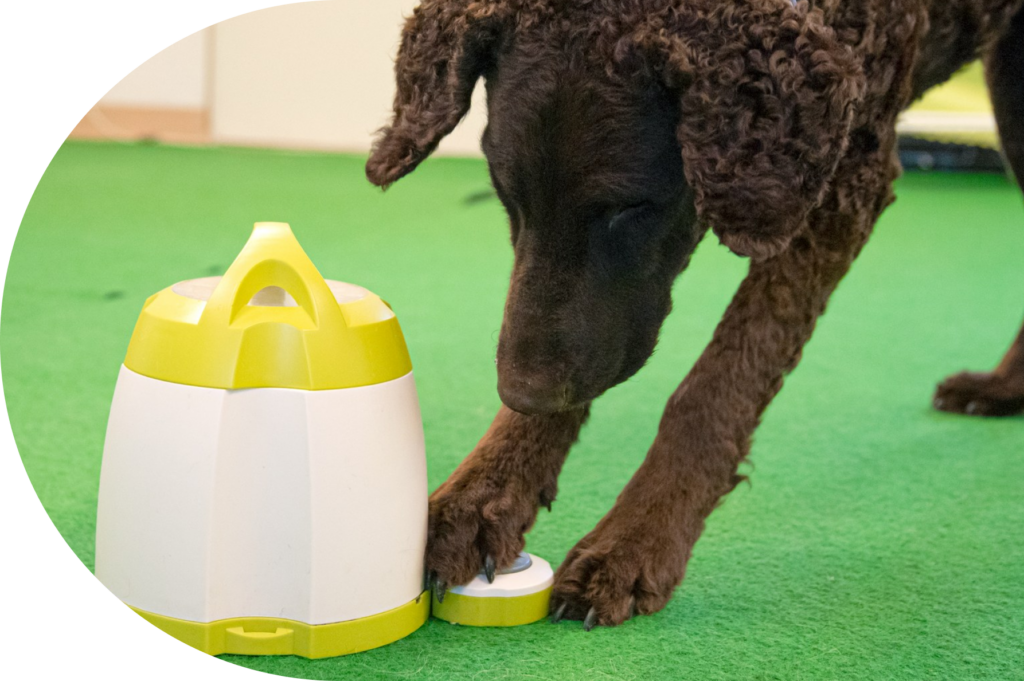
The most popular test for an adult dog! This test will give you a comprehensive overview of your dog’s cognitive and personality characteristics. We recommend this as the first test for an adult dog. Although the total duration of smartDOG COGNITION is about 1.5 hours, still 99% of dogs are fully motivated throughout the test – regardless of breed. Dog’s concentration is also measured during long-term performance and for an adult dog (over 11-12 months, no upper age limit) this test is definitely the most recommended and also the most popular test.
The test has been scientifically proven to measure a dog’s impulsiveness, trainability and speed of learning (read our latest study here).
smartDOG™ COGNITION – comprehensive assessment of cognitive characteristics 201 € (incl. VAT 25,5%)
If you want, you can also select addition SURFACES testing, where we check the dog’s willingness to walk in various surfaces (15,20€)
Arden, R. & Adams M.J. 2016. A general intelligence factor in dogs. Intelligence 55: 79–85
Bray et al., 2021.Early-emerging and highly heritable sensitivity to human communication in dogs. Current Biology 31, 1–5. https://doi.org/10.1016/j.cub.2021.04.055
Gnanadesikan, G.E., Hare, B., Snyder-Mackler, N., and MacLean, E.L. (2020). Estimating the heritability of cognitive traits across dog breeds re- veals highly heritable inhibitory control and communication factors. Anim. Cogn. 23, 953–964.
Krause et al. 2018: Animal Pointing: Changing Trends and Findings From 30 Years of Research. Journal of Comparative Psychology. http://dx.doi.org/10.1037/com0000125
Lazarowski, L., Strassberg, L. R., Waggoner, L. P., & Katz, J. S. (2019). Persistence and human-directed behavior in detection dogs: Ontogenetic development and relationships to working dog success. Applied Animal Behaviour Science, 220. doi:https://doi.org/10. 1016/j.applanim.2019.104860
MacLean, E., & Hare, B. (2018). Enhanced selection of assistance and explosive detection dogs using cognitive measures. Frontiers in Veterinary Science, 5(October), 236. doi:https://doi.org/10.3389/ FVETS.2018.00236
Miklo ́ si, A., Kubinyi, E., Topa ́ l, J., Ga ́ csi, M., Vira ́ nyi, Z., and Csa ́ nyi, V. (2003). A simple reason for a big difference: wolves do not look back at hu- mans, but dogs do. Curr. Biol. 13, 763–766.
Miklósi, Á., & Soproni, K. (2006). A comparative analysis of animals’ understanding of the human pointing gesture. Animal Cognition, 9, 81–93. http://dx.doi.org/10.1007/s10071-005-0008-1
Oliva, J. L., Rault, J.-L., Appleton, B., & Lill, A. (2015). Oxytocin enhances the appropriate use of human social cues by the domestic dog (Canis familiaris) in an object choice task. Animal Cognition, 18, 767–775. http://dx.doi.org/10.1007/s10071-015-0843-7
Passalacqua C, Marshall-Pescini S, Barnard S, Lakatos G, Valsecchi P, Prato-Previde E (2011) Breed and age group differences in human-directed gazing behaviour. Anim Behav 82:1043–1050 Persson ME, Roth LSV, Johnsson M, Wright D, Jensen P (2015) Human-directed social behaviour in dogs shows significant heritability. Genes Brain Behav 14(4):337–344
Soproni, K., Miklósi, Á., Topál, J., and Csányi, V. (2001). Comprehension of human communicative signs in pet dogs (Canis familiaris). J. Comp. Psychol. 115, 122–126.
Tiira, K., Tikkanen, A. & Vainio, O. 2020. Inhibitory control – important trait for explosive detection performance in police dogs? Applied Animal Behaviour Science. doi:10.1016/j.applanim.2020.104942